
If you’ve never been to one of our Creative Meet-Ups, the name probably doesn’t explain very much.
They aren’t really workshops. They aren’t networking events. You don’t need to arrive with a project to pitch, and nobody is going to make you stand in a circle and explain what kind of artist you are.
Usually, you come in, get a drink or a snack, meet whoever is around, and we explain a bit about what we’re working on that evening.
Then we get stuck into something.
There’s usually a project, but not a fixed job for everyone
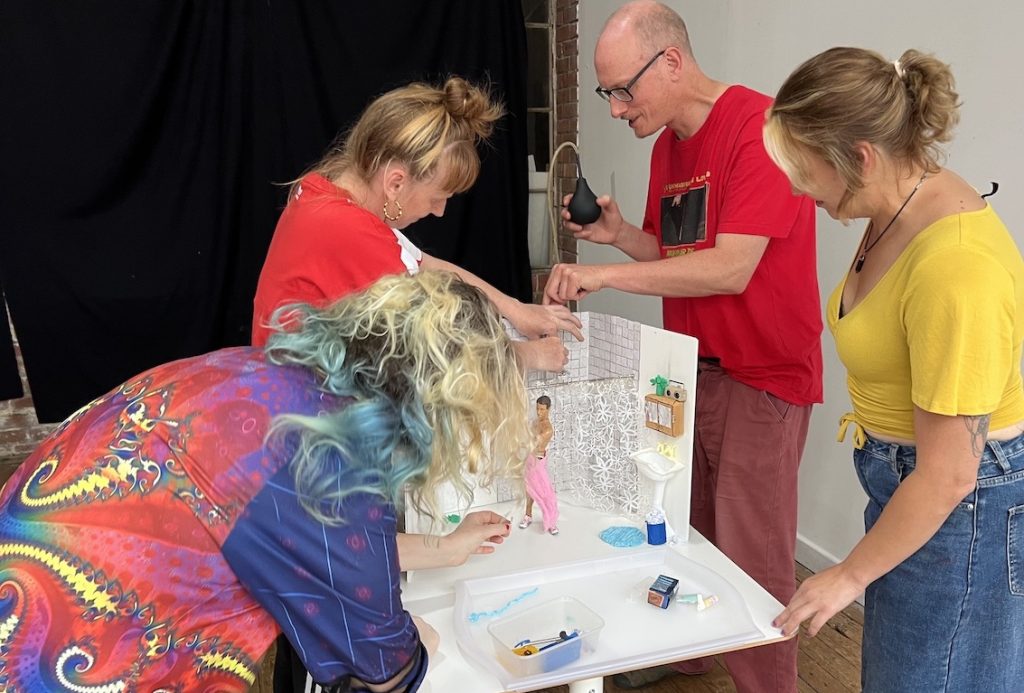
A lot of our Creative Meet-Ups revolve around longer collaborative projects that develop over a number of sessions.
That means we might spend several months moving something from an early idea through different kinds of experimentation and eventually towards some sort of finished work or public outcome.
Exactly what people are doing can change a lot along the way.
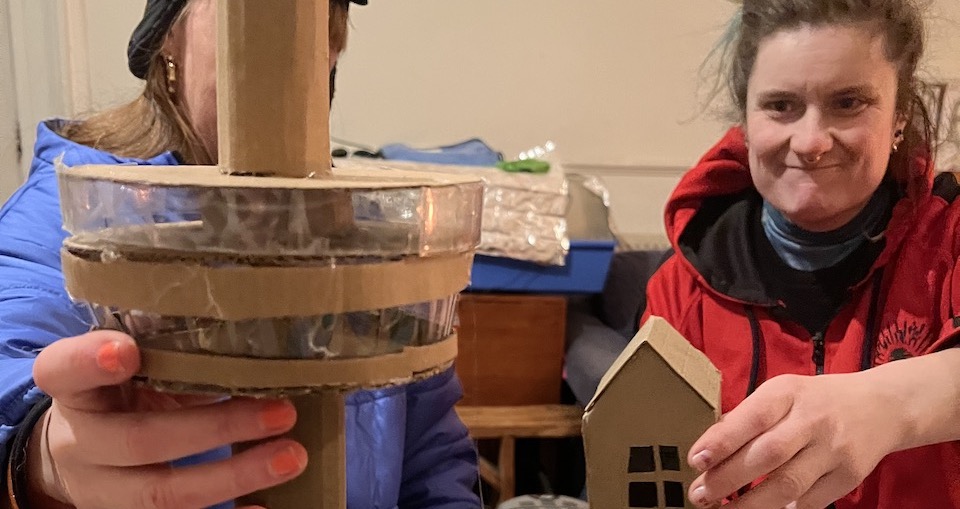
One evening might involve building things out of cardboard. Another might involve writing, drawing, sound, puppets, photography, digital tools, working out how an installation might fit together, or solving some strange practical problem we hadn’t anticipated.
So far, quite a lot of our longer projects have involved film, video or moving image more generally somewhere along the way, but that doesn’t mean every activity looks like filmmaking, or that everything we make has to end up as a film.
Cardboard Liverpool, for example, started as a special collaborative making session and is now becoming an installation for Zine Station. Other work has moved into more immersive or interactive territory, and we’re interested in exploring things like zines, games, projection and installation much further.
The point is not the medium.
The point is making something together.
Collaborative doesn’t mean completely unstructured
There is planning behind the sessions.
PVTV’s lead facilitators normally look at where a project is going and work out what might help it move forward next.
That matters because people come and go. Some people are there most months. Somebody else might be walking through the door for the first time halfway through a project.

A completely self-organising group sounds appealing, but in practice it can be difficult to keep a long project moving when everybody has different amounts of context, confidence and availability.
So we provide some structure and some possible ways into whatever is happening.
From there, people can take things in unexpected directions.
That is part of what we want.
The longer-term aim is to make the group increasingly confident about organising and directing its own creative work, while still having enough support around it that somebody new can turn up and actually understand how to join in.
Sometimes we deliberately do something smaller
Long projects can be satisfying, but they can also become intense.
So between them, or when we need a change of pace, we sometimes run shorter experiments where the point is simply to have a go at something and see what happens.
That might mean making cardboard models, trying trick photography, experimenting with writing, making puppets or testing some other idea that can produce something quickly.
Those sessions give people the satisfaction of making something without needing to understand months of previous work.
They also often teach us techniques that end up becoming useful somewhere else later.

You don’t have to be good at everything
This is probably the most important bit.
You don’t need to arrive thinking of yourself as an artist.
You don’t need a finished idea.
You don’t need professional skills.
And you definitely don’t need to be good at everything we happen to be doing that month.
People in the group have very different levels of experience and very different interests. Somebody might be comfortable with a camera but terrible with cardboard. Somebody else might draw, write, build things, make music, understand electronics, or simply have a brilliant idea nobody else would have thought of.
Oddly, that mixture is part of what gives the work its character.
If everything was made by one person with one technique and one level of polish, it would look very different.
Instead, things come together out of lots of different hands, skills and ways of thinking.
Sometimes the rough bit works next to the polished bit precisely because neither one is pretending to be the whole thing.
We share skills rather than teach a class
There is a lot of learning at the Creative Meet-Ups, but we’re careful about calling them workshops.
Nobody at the front has all the answers.
People in the room know different things, and those skills get shared as we work.
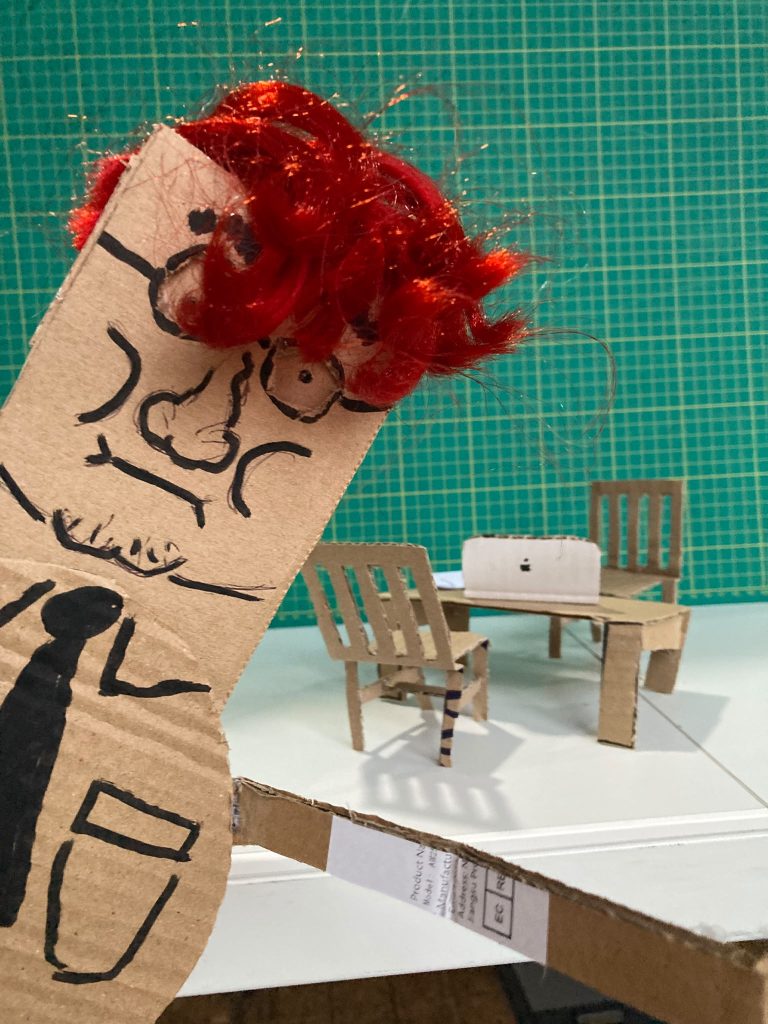
Someone may know a better way to attach a puppet joint. Somebody else might understand sound. Somebody might have used a particular piece of software before. Sometimes we all try something and discover together that it absolutely does not work.
That counts too.
The idea is closer to…
“Here’s what we’re trying to make. What can we figure out together?”
than…
“Here is today’s lesson.”
The social bit matters as well
Creative Meet-Ups are also social spaces, but the socialising happens mostly through doing something together.
That’s deliberate.

Traditional networking can be pretty uncomfortable if you don’t already know people or feel like you have something impressive to say about yourself.
It is much easier to start talking to somebody when you’re both cutting up cardboard, trying to fix an arm onto a puppet, drawing something, or arguing about whether an obviously terrible idea might actually be brilliant.
There are free drinks and snacks, there is usually plenty of conversation, and nobody needs to arrive knowing anyone else.
We’re also interested in taking that social side outside the sessions more: visiting exhibitions, screenings, performances and other cultural things together, particularly when something the group has made gets shown publicly.
If you’re thinking about coming along
The main thing is just to come.
You can be awkward. Most of us probably are.
You can be bad at making things.
You can arrive without an idea.
You can ask what’s going on.
You can disagree with something.
You can try something, make a mess of it, and then try something else.
There will usually be enough structure to give you somewhere to start, but what happens after that depends on the people in the room.
That is basically the whole point.
Leave a Reply