

Sometimes the easiest way into a collaborative project is simply to start making something.
After several months developing the story for our Temu Telepathy Pill project, our August Creative Meet-Up at DoES Liverpool was deliberately much more practical. We brought cardboard, glue guns, skewers, bottles, fabric, string and a pile of other materials and started figuring out how some very simple puppets might actually work.
There wasn’t a finished puppet design everyone had to follow. The idea was to make quick tests, compare what people discovered and let the techniques develop through doing.
That turned out to be a lot of fun.

Figuring it out as we went
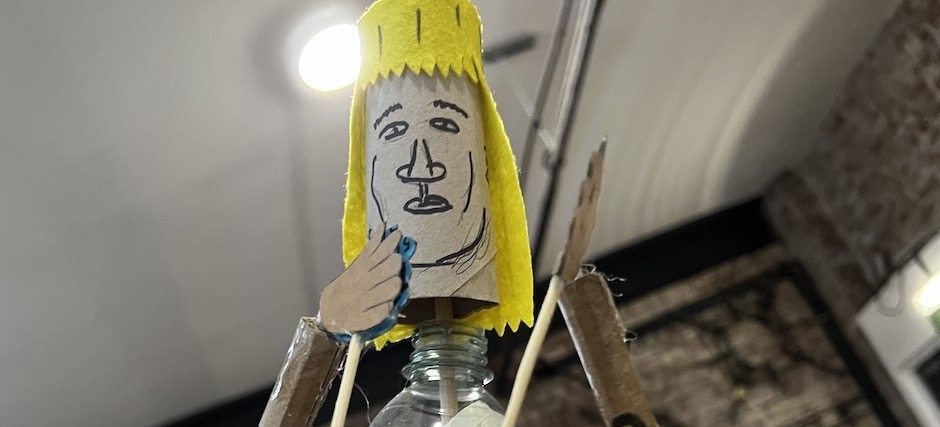
Most people experimented with simple rod puppets.
Once the basic joints were working, the movement was surprisingly effective, using wooden skewers to control the arms. Small changes in how the arms hung, where the rods were attached and how the puppet was handled immediately started giving the characters different personalities.
People began learning from one another as they worked. Some puppets gained clothes. Different heads were tried on the same bodies. Hair, fabric and other loose materials added extra movement after the main action had stopped, which helped even very simple constructions feel more alive.
One person went in a completely different direction, developing a puppet intended to be operated by putting a hand inside a cardboard body. The mechanism still needed solving, but the construction itself became fascinating, particularly as string was sewn into the head to create hair.

There were plenty of smaller engineering discoveries too.
Our rod-puppet bodies were made from plastic water bottles, which created the unforeseen production problem that we first had to drink quite a lot of water before we could build anything. Eventually somebody remembered that we could pour the water into glasses instead.
Progress.
Tools, tests and terrible He-Man
We also had our first proper go with a new Proxxon rotary tool, bought with support from Liverpool CVS’s Community Impact Fund and the People’s Postcode Lottery Grassroots Grant programme.
Being able to cut and shape small components quickly made a noticeable difference. As the Meet-Ups move further into puppetry, models, props and other physical work, having decent tools makes it much easier to experiment without every tiny construction job becoming an ordeal.
One puppet started out as an attempt at a blonde woman and somehow ended up looking considerably more like He-Man.
That was probably useful too.
The point of these early tests isn’t to make polished finished characters. It is to understand what different materials and mechanisms actually do once somebody starts moving them.
That fits something we’ve been learning more generally through the Creative Meet-Ups: rough prototypes can be much more useful than sitting around trying to design the perfect solution in advance. The August session reinforced that practical making can work well as informal supported activity, without everybody having to make the same thing or follow a formal class structure.
Meanwhile, somebody has to work out the shots
Not everybody wanted to spend the session constructing puppets.
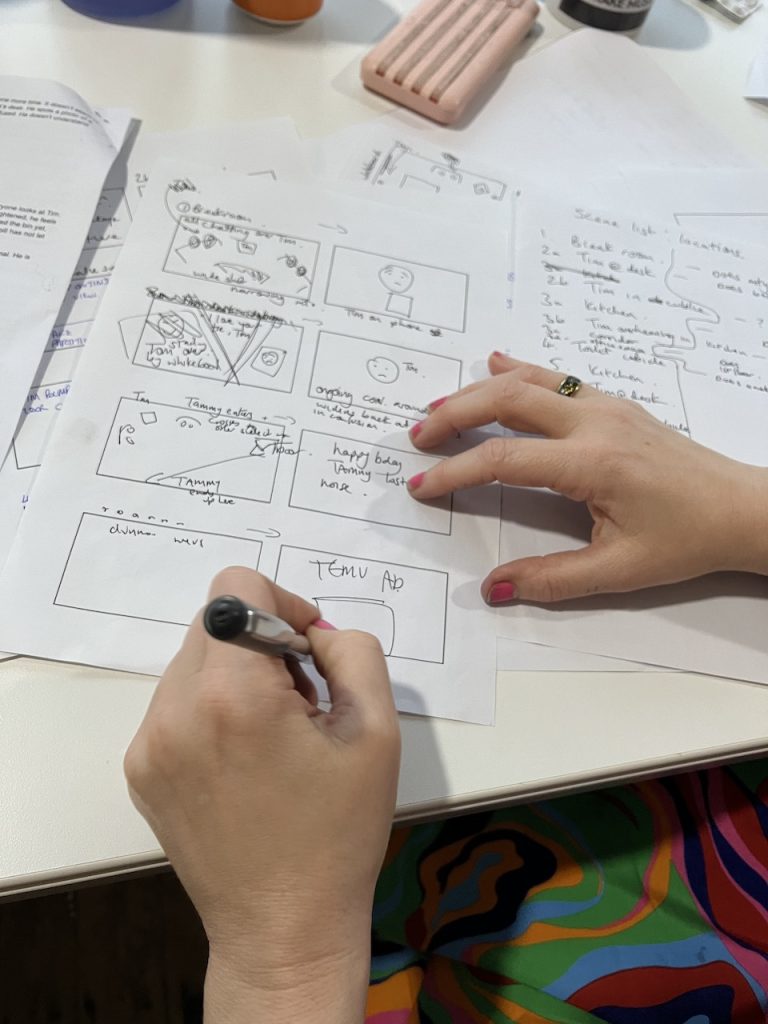
At another part of the table, people were working through the Temu Telepathy Pill story and starting to turn scenes into storyboards: thinking about where characters would sit, what the camera might see, and how different moments could actually be staged.

That’s increasingly how we want the Creative Meet-Ups to work.
A shared project doesn’t mean everybody has to be interested in the same bit of it. One person might want to build something. Somebody else might draw, storyboard, perform, work on sound, think about camera movement, make props or solve a technical problem.
What next?
We’d like to spend more time exploring puppetry.
The next steps could include clothing, better rod-puppet handling and simple trigger mechanisms that allow movement beyond the basic arms. The August tests also showed that actually operating a puppet is its own skill: once you’ve built all the moving pieces, you then have to learn how to make them behave convincingly. Those are among the areas identified for further experimentation in the session review.
Further ahead, we’re interested in pushing some of these techniques much further. For The Visionaries, for example, we’re developing ideas for puppets whose heads begin as 3D designs in Blender and are turned into moulds for physical faces and skins.
So the path can run in either direction:
cardboard and bottles – physical puppet – digital tools
or…
digital character design – fabrication – physical puppet
For now, though, we’re still at the very useful stage of cardboard, skewers, improvised mechanisms and seeing what moves.
And we’d like to do a lot more of it.
Leave a Reply